

More than 2× the eradication rate in patients with clarithromycin resistance
SUPERIORITY ENDPOINT IN PATIENTS WITH
CLARITHROMYCIN-RESISTANT STRAINS (mITT)
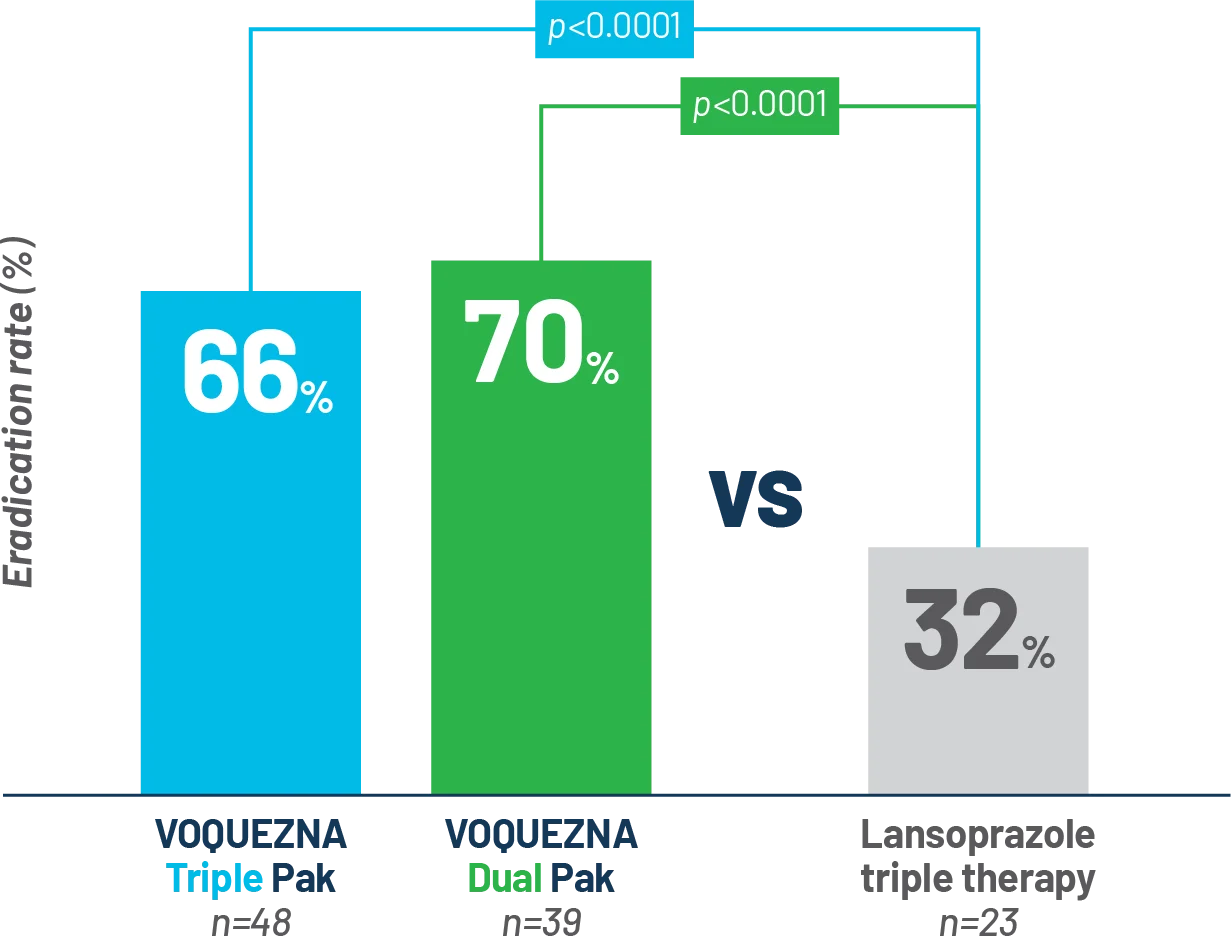
Powerful vs resistant strains
Powerful vs resistant strains
VOQUEZNA® TRIPLE PAK® and VOQUEZNA® DUAL PAK® are contraindicated in patients with known hypersensitivity to vonoprazan or amoxicillin, any other components of the formulation, any other beta-lactams, or in patients receiving rilpivirine-containing products.
Due to the clarithromycin component, VOQUEZNA TRIPLE PAK is also contraindicated in patients with any known hypersensitivity to clarithromycin or any macrolide antibiotic, in patients receiving pimozide, lomitapide, lovastatin, simvastatin, ergotamine, dihydroergotamine, lurasidone, colchicine in patients with renal or hepatic impairment, or those with a history of cholestatic jaundice/hepatic dysfunction.
Hypersensitivity Reactions: Serious and occasionally fatal reactions (e.g., anaphylaxis) have been reported with components of VOQUEZNA TRIPLE PAK and VOQUEZNA DUAL PAK. If hypersensitivity reactions occur, discontinue use and institute immediate therapy (e.g., anaphylaxis management).
Acute Tubulointerstitial Nephritis: Acute tubulointerstitial nephritis (TIN) has been reported with vonoprazan, a component of VOQUEZNA TRIPLE PAK or VOQUEZNA DUAL PAK. If suspected, discontinue VOQUEZNA TRIPLE PAK or VOQUEZNA DUAL PAK and evaluate patients with suspected acute TIN.
Severe Cutaneous Adverse Reactions (SCAR): Discontinue use of VOQUEZNA TRIPLE PAK or VOQUEZNA DUAL PAK at first signs or symptoms of SCAR or other signs of hypersensitivity and consider further evaluation. SCAR, including Stevens-Johnson syndrome (SJS) and toxic epidermal necrolysis (TEN) have been reported with the components of both products. In addition, drug reaction with eosinophilia and systemic symptoms (DRESS), and acute generalized exanthematous pustulosis (AGEP) have been reported with amoxicillin and clarithromycin.
Drug-Induced Enterocolitis Syndrome: Drug-induced enterocolitis syndrome (DIES) has been reported with use of amoxicillin, a component of VOQUEZNA TRIPLE PAK and VOQUEZNA DUAL PAK, with most cases occurring in pediatric patients ≤18 years of age. DIES is a non-IgE mediated hypersensitivity reaction characterized by protracted vomiting occurring 1 to 4 hours after drug ingestion in the absence of skin or respiratory symptoms. DIES may be associated with pallor, lethargy, hypotension, shock, diarrhea within 24 hours after ingesting amoxicillin, and leukocytosis with neutrophilia. If DIES occurs, discontinue VOQUEZNA TRIPLE PAK or VOQUEZNA DUAL PAK and institute appropriate therapy.
Clostridioides difficile-associated diarrhea (CDAD): Evaluate if diarrhea occurs with VOQUEZNA TRIPLE PAK or VOQUEZNA DUAL PAK. CDAD has been reported with use of acid suppressing therapies and nearly all antibacterial agents, and may range in severity from mild diarrhea to fatal colitis. If CDAD is confirmed, discontinue therapy and treat appropriately.
Rash in Patients with Mononucleosis: A high percentage of patients with mononucleosis who receive amoxicillin (a component of VOQUEZNA TRIPLE PAK and VOQUEZNA DUAL PAK) develop an erythematous skin rash. Avoid use of both products in patients with mononucleosis.
Interactions with Diagnostic Investigations for Neuroendocrine Tumors: Serum chromogranin A (CgA) levels increase secondary to drug-induced decreases in gastric acidity. The increased CgA level may cause false positive results in diagnostic investigations for neuroendocrine tumors. Assess CgA levels at least 4 weeks after VOQUEZNA TRIPLE PAK and VOQUEZNA DUAL PAK treatment and consider repeating the test if initial CgA levels are high.
QT Prolongation: Avoid VOQUEZNA TRIPLE PAK in patients with known QT prolongation or receiving drugs known to prolong the QT interval, ventricular arrhythmia (torsades de pointes), hypokalemia/hypomagnesemia, significant bradycardia, or taking Class IA or III antiarrhythmics.
Hepatotoxicity: Discontinue use of VOQUEZNA TRIPLE PAK if signs and symptoms of hepatitis occur.
Serious adverse reactions due to concomitant use with other drugs: Serious adverse reactions can occur with VOQUEZNA TRIPLE PAK due to drug interactions of clarithromycin with colchicine, some lipid lowering agents, some calcium channel blockers, hypoglycemic agents including insulin, quetiapine, warfarin, benzodiazepines, and other drugs.
Embryo-Fetal Toxicity: VOQUEZNA TRIPLE PAK is not recommended for use in pregnancy as clarithromycin may cause fetal harm.
Myasthenia Gravis: Exacerbation of myasthenia gravis can occur with VOQUEZNA TRIPLE PAK since it has been reported in patients receiving clarithromycin tablets.
VOQUEZNA TRIPLE PAK: The most common adverse reactions (≥2%) include dysgeusia (4.6%), diarrhea (4.0%), vulvovaginal candidiasis (3.2%), headache (2.6%), abdominal pain (2.3%), and hypertension (2.0%).
VOQUEZNA DUAL PAK: The most common adverse reactions (≥2%) include diarrhea (5.2%), abdominal pain (2.6%), vulvovaginal candidiasis (2.0%), and nasopharyngitis (2.0%).
Components of VOQUEZNA TRIPLE PAK and VOQUEZNA DUAL PAK have the potential for clinically important drug interactions. See full Prescribing Information for important drug interactions.
Pregnancy: VOQUEZNA TRIPLE PAK is not recommended for use in pregnancy as clarithromycin may cause fetal harm. There is a pregnancy exposure registry that monitors pregnancy outcomes in women exposed to VOQUEZNA TRIPLE PAK or VOQUEZNA DUAL PAK during pregnancy. Healthcare providers are encouraged to register patients by calling 1-866-609-1612 or visiting https://voqueznapregnancyregistry.com/.
Lactation: There are no data on the effects of vonoprazan on the breastfed child or the effects on milk production. The developmental and health benefits of breastfeeding should be considered along with the mother’s clinical need for VOQUEZNA TRIPLE PAK or VOQUEZNA DUAL PAK and any potential adverse effects on the breastfed child from VOQUEZNA TRIPLE PAK or VOQUEZNA DUAL PAK or from the underlying maternal condition. Monitor infants exposed to clarithromycin or amoxicillin through breast milk for diarrhea, vomiting or rash.
Geriatrics: VOQUEZNA TRIPLE PAK increased risk of torsades de pointes due to clarithromycin.
Renal and Hepatic Impairment: Use is not recommended in patients with severe renal impairment and use is not recommended in patients with moderate to severe hepatic impairment.
VOQUEZNA TRIPLE PAK is a co-packaged product containing vonoprazan, a potassium-competitive acid blocker (PCAB), amoxicillin, a penicillin-class antibacterial, and clarithromycin, a macrolide antimicrobial. VOQUEZNA DUAL PAK is a co-packaged product containing vonoprazan and amoxicillin. Both products are indicated for the treatment of Helicobacter pylori infection in adults.
To reduce the development of drug-resistant bacteria and maintain the effectiveness of VOQUEZNA TRIPLE PAK, VOQUEZNA DUAL PAK, and other antibacterial drugs, both products should be used only to treat or prevent infections that are proven or strongly suspected of being caused by bacteria.
You are encouraged to report suspected adverse reactions by contacting Phathom Pharmaceuticals at 1-888-775-PHAT (7428)1-888-775-PHAT (7428) or FDA at 1-800-FDA-10881-800-FDA-1088 or www.fda.gov/medwatch.
Please click here for full Prescribing Information for VOQUEZNA TRIPLE PAK and VOQUEZNA DUAL PAK.
Reference: 1. VOQUEZNA TRIPLE PAK AND VOQUEZNA DUAL PAK. Prescribing Information. Phathom Pharmaceuticals; 2025.
VOQUEZNA® TRIPLE PAK® and VOQUEZNA® DUAL PAK® are contraindicated in patients with known hypersensitivity to vonoprazan or amoxicillin, any other components of the formulation, any other beta-lactams, or in patients receiving rilpivirine-containing products.
Due to the clarithromycin component, VOQUEZNA TRIPLE PAK is also contraindicated in patients with any known hypersensitivity to clarithromycin or any macrolide antibiotic, in patients receiving pimozide, lomitapide, lovastatin, simvastatin, ergotamine, dihydroergotamine, lurasidone, colchicine in patients with renal or hepatic impairment, or those with a history of cholestatic jaundice/hepatic dysfunction.
Hypersensitivity Reactions: Serious and occasionally fatal reactions (e.g., anaphylaxis) have been reported with components of VOQUEZNA TRIPLE PAK and VOQUEZNA DUAL PAK. If hypersensitivity reactions occur, discontinue use and institute immediate therapy (e.g., anaphylaxis management).
Acute Tubulointerstitial Nephritis: Acute tubulointerstitial nephritis (TIN) has been reported with vonoprazan, a component of VOQUEZNA TRIPLE PAK or VOQUEZNA DUAL PAK. If suspected, discontinue VOQUEZNA TRIPLE PAK or VOQUEZNA DUAL PAK and evaluate patients with suspected acute TIN.
Severe Cutaneous Adverse Reactions (SCAR): Discontinue use of VOQUEZNA TRIPLE PAK or VOQUEZNA DUAL PAK at first signs or symptoms of SCAR or other signs of hypersensitivity and consider further evaluation. SCAR, including Stevens-Johnson syndrome (SJS) and toxic epidermal necrolysis (TEN) have been reported with the components of both products. In addition, drug reaction with eosinophilia and systemic symptoms (DRESS), and acute generalized exanthematous pustulosis (AGEP) have been reported with amoxicillin and clarithromycin.
Drug-Induced Enterocolitis Syndrome: Drug-induced enterocolitis syndrome (DIES) has been reported with use of amoxicillin, a component of VOQUEZNA TRIPLE PAK and VOQUEZNA DUAL PAK, with most cases occurring in pediatric patients ≤18 years of age. DIES is a non-IgE mediated hypersensitivity reaction characterized by protracted vomiting occurring 1 to 4 hours after drug ingestion in the absence of skin or respiratory symptoms. DIES may be associated with pallor, lethargy, hypotension, shock, diarrhea within 24 hours after ingesting amoxicillin, and leukocytosis with neutrophilia. If DIES occurs, discontinue VOQUEZNA TRIPLE PAK or VOQUEZNA DUAL PAK and institute appropriate therapy.
Clostridioides difficile-associated diarrhea (CDAD): Evaluate if diarrhea occurs with VOQUEZNA TRIPLE PAK or VOQUEZNA DUAL PAK. CDAD has been reported with use of acid suppressing therapies and nearly all antibacterial agents, and may range in severity from mild diarrhea to fatal colitis. If CDAD is confirmed, discontinue therapy and treat appropriately.
Rash in Patients with Mononucleosis: A high percentage of patients with mononucleosis who receive amoxicillin (a component of VOQUEZNA TRIPLE PAK and VOQUEZNA DUAL PAK) develop an erythematous skin rash. Avoid use of both products in patients with mononucleosis.
Interactions with Diagnostic Investigations for Neuroendocrine Tumors: Serum chromogranin A (CgA) levels increase secondary to drug-induced decreases in gastric acidity. The increased CgA level may cause false positive results in diagnostic investigations for neuroendocrine tumors. Assess CgA levels at least 4 weeks after VOQUEZNA TRIPLE PAK and VOQUEZNA DUAL PAK treatment and consider repeating the test if initial CgA levels are high.
QT Prolongation: Avoid VOQUEZNA TRIPLE PAK in patients with known QT prolongation or receiving drugs known to prolong the QT interval, ventricular arrhythmia (torsades de pointes), hypokalemia/hypomagnesemia, significant bradycardia, or taking Class IA or III antiarrhythmics.
Hepatotoxicity: Discontinue use of VOQUEZNA TRIPLE PAK if signs and symptoms of hepatitis occur.
Serious adverse reactions due to concomitant use with other drugs: Serious adverse reactions can occur with VOQUEZNA TRIPLE PAK due to drug interactions of clarithromycin with colchicine, some lipid lowering agents, some calcium channel blockers, hypoglycemic agents including insulin, quetiapine, warfarin, benzodiazepines, and other drugs.
Embryo-Fetal Toxicity: VOQUEZNA TRIPLE PAK is not recommended for use in pregnancy as clarithromycin may cause fetal harm.
Myasthenia Gravis: Exacerbation of myasthenia gravis can occur with VOQUEZNA TRIPLE PAK since it has been reported in patients receiving clarithromycin tablets.
VOQUEZNA TRIPLE PAK: The most common adverse reactions (≥2%) include dysgeusia (4.6%), diarrhea (4.0%), vulvovaginal candidiasis (3.2%), headache (2.6%), abdominal pain (2.3%), and hypertension (2.0%).
VOQUEZNA DUAL PAK: The most common adverse reactions (≥2%) include diarrhea (5.2%), abdominal pain (2.6%), vulvovaginal candidiasis (2.0%), and nasopharyngitis (2.0%).
Components of VOQUEZNA TRIPLE PAK and VOQUEZNA DUAL PAK have the potential for clinically important drug interactions. See full Prescribing Information for important drug interactions.
Pregnancy: VOQUEZNA TRIPLE PAK is not recommended for use in pregnancy as clarithromycin may cause fetal harm. There is a pregnancy exposure registry that monitors pregnancy outcomes in women exposed to VOQUEZNA TRIPLE PAK or VOQUEZNA DUAL PAK during pregnancy. Healthcare providers are encouraged to register patients by calling 1-866-609-1612 or visiting https://voqueznapregnancyregistry.com/.
Lactation: There are no data on the effects of vonoprazan on the breastfed child or the effects on milk production. The developmental and health benefits of breastfeeding should be considered along with the mother’s clinical need for VOQUEZNA TRIPLE PAK or VOQUEZNA DUAL PAK and any potential adverse effects on the breastfed child from VOQUEZNA TRIPLE PAK or VOQUEZNA DUAL PAK or from the underlying maternal condition. Monitor infants exposed to clarithromycin or amoxicillin through breast milk for diarrhea, vomiting or rash.
Geriatrics: VOQUEZNA TRIPLE PAK increased risk of torsades de pointes due to clarithromycin.
Renal and Hepatic Impairment: Use is not recommended in patients with severe renal impairment and use is not recommended in patients with moderate to severe hepatic impairment.
VOQUEZNA TRIPLE PAK is a co-packaged product containing vonoprazan, a potassium-competitive acid blocker (PCAB), amoxicillin, a penicillin-class antibacterial, and clarithromycin, a macrolide antimicrobial. VOQUEZNA DUAL PAK is a co-packaged product containing vonoprazan and amoxicillin. Both products are indicated for the treatment of Helicobacter pylori infection in adults.
To reduce the development of drug-resistant bacteria and maintain the effectiveness of VOQUEZNA TRIPLE PAK, VOQUEZNA DUAL PAK, and other antibacterial drugs, both products should be used only to treat or prevent infections that are proven or strongly suspected of being caused by bacteria.
You are encouraged to report suspected adverse reactions by contacting Phathom Pharmaceuticals at 1-888-775-PHAT (7428)1-888-775-PHAT (7428) or FDA at 1-800-FDA-10881-800-FDA-1088 or www.fda.gov/medwatch.
Please click here for full Prescribing Information for VOQUEZNA TRIPLE PAK and VOQUEZNA DUAL PAK.